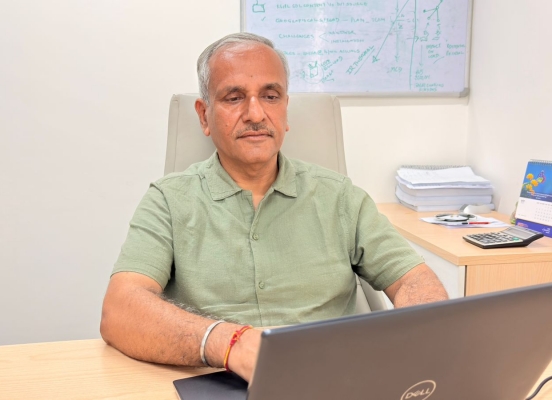

Dr. Bharat Bhushan- Executive Director, Radius Synergies International
India's Electric Future: Infrastructure, Silicon, and the Road to 2030
- By TNM TEAM --
- Sunday, 31 May, 2026
India is gaining momentum for extensive EV adoption, and the country's policies are rapidly being defined and aligned to match that ambition. Yet among all the dimensions being debated, including incentives, tariffs and manufacturing mandates, one area stands above the rest when viewed through the consumer's lens: the establishment of an efficient, effective and robust public charging infrastructure, including the deeply complex question of grid stability. Range anxiety remains an important concern from end users' point of view, and while technologies that help increase range are steadily evolving, having an extensive, affordable and reliable public charging infrastructure would be a genuine piece of mind and a true catalyst for accelerating EV adoption to meet the 2030 goals laid down by the Government of India.
The scale of the challenge is stark. As of now, the scale of charging infrastructure is much less than what is currently required or envisaged for the near future, and whatever is available also isn't reliable for high uptime. As a ball park, India needs almost 50x of charging stations compared to what it has today and that too highly reliable ones. Strengthening this has to be an outcome of several dimensions, requiring close coordination and policy alignment between equipment manufacturers, charging point operators, energy distribution companies and ministries like the power ministry and road transport and highway ministry, alongside policy think tanks and innovative technology companies that can leverage contemporary technologies like AI/ML, big data and analytics. Technology intervention is a must to create the required intelligence that can build a nationwide, data-driven intelligent ecosystem, one that is able to offer a countrywide integrated and reliable public charging infrastructure.
Underneath the charging network lies an equally urgent question: who makes the components? One of the major bottlenecks for the Indian industry has been its heavy reliance on imported semiconductors. With a major transition towards EV adoption underway, the need for such components will be extensive, be it for batteries, Battery Management Systems (BMS), EV electronic components, public charging infrastructure or smart grids and smart metering, just to name a few. Unless these needs are majorly fulfilled by local manufacturers, this could lead to a massive surge in imports. Localization and semiconductor manufacturing will therefore play a very critical role in the success of the EV market and EV future as a whole. It is something that must be taken up in a mission critical mode. It will help reduce import dependencies as well as drive affordability. The government is already providing the required help and working in close association with the industry for making India a global hub for chip manufacturing in the near future.
None of this, however, will matter if the vehicles themselves aren't safe. Thermal management and battery safety are the very basic and very important aspects that are a must for accelerating EV adoption. India witnessed some odd incidents of EVs catching fire in the recent past. While such incidents have happened with fossil fuel-run vehicles also, anything new that is coming up causes more concern and draws higher attention. Utmost attention in terms of policies, manufacturing, quality control and operational and charging safety needs to be institutionalized at all levels to eliminate any such problems that can be a speed breaker in EV adoption. At a policy level, the government has already mandated strict norms like AIS-156, which focus on battery safety, thermal management and more reliable battery management systems. At a field level, more attention needs to be paid in terms of do's and don'ts, proper training for safety, battery handling, charging, replacing, over-loading and short circuits in a more formalized and safe manner, instead of a 'jugaar mindset'.
Taken together, charging infrastructure at scale, domestic semiconductor capability and uncompromising battery safety form the foundation of something far larger: India's credible bid to become a global hub for EV manufacturing and innovation by 2030. An added advantage is that India is already a preferred global hub for automobile manufacturing. The entire ecosystem being envisioned through government-driven policies in terms of chip manufacturing, battery-related innovations, EV production, power sector reforms and infrastructure growth can surely take India closer to this goal. A lot is happening at the global level too on these subjects, which can be considered as macro-level environmental risks. Localization, innovation and efficient execution will be the critical factors to accomplish this target and the way the EV momentum is going, it is a high possibility that India turns out to be exactly that.
economics- Related News